
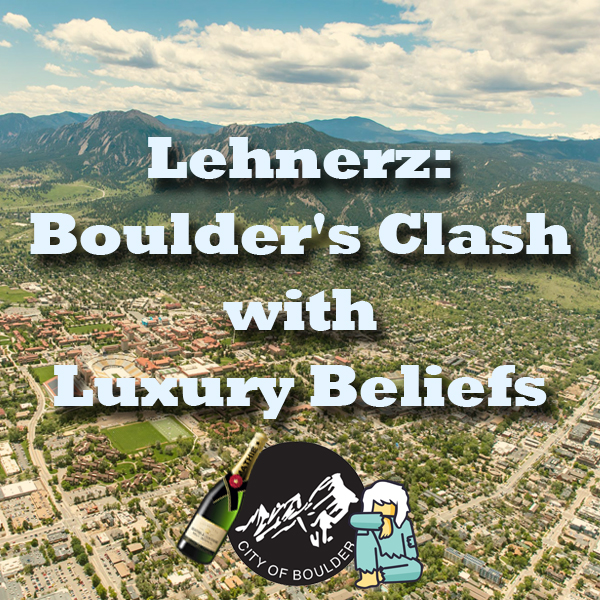
Guest post by Frank Lehnerz:
Troubled, Boulder
Jon Caldara, host of The Devil’s Advocate and the President of the Independence Institute recently posed a question in a column: “What is it about Boulder?”
This comes from one of Caldara’s usual sharply critical, yet witty, columns in response to the recent terrorist attack.
Or as some in the regime “fiery but mostly peaceful protests” media called “terrorist attack” that took place on the city’s Pearl Street on a group of people trying to raise awareness for the Israeli hostages held by Hamas.
The assailant was an anti-Zionist, likely anti-Semitic, Egyptian national who was in the United States illegally on an expired visa, yet was reportedly still able to obtain a Colorado driving license under the policies passed by the state’s new rulers.
Caldara noted that Boulder has been a unique hotbed for high-profile violent events, including the still-unsolved murder of child pageant star JonBenet Ramsey; the murder-suicide involving Gordon Hood and the pilot he hired; the open case concerning the death of Robert Redford’s daughter’s boyfriend; and several mass shooting sprees, including those committed by escaped prisoner Michael Bell and the gunman in the 2021 King Soopers shooting.
A pattern Caldara identified in nearly all of these cases is that the perpetrators were not locals—they came to Boulder from elsewhere. In his view, they were seemingly drawn there.
He continues:
“Or maybe, just maybe, the arrogance of the place quietly pulls people to unleash their madness there.
“Does Boulder’s self-satisfaction and elitism lodge in the brains of the disrupted, unconsciously tickling until it’s scratched by violence?
“The city pastime in Boulder is not baseball. It’s virtue signaling.”
Poor Boulder, some may say – it’s always a punching bag among those outside the Progressive bubble.
But perhaps Caldara is onto something.
Enter: luxury beliefs.
Author Rob Henderson coined the term luxury beliefs to describe in his words, “ideas and opinions that confer status on the upper class at very little cost, while often inflicting costs on the lower classes.”
As chronicled in his autobiography Troubled: A Memoir of Foster Care, Family, and Social Class, Henderson’s early childhood began living in a car on the streets of Los Angeles with his drug-addicted mother, followed by a turbulent tour through the foster care system. He eventually was adopted by what he thought was a stable family, but that dream soon collapsed. With poor grades and a lack of drive to enter college, he enlisted in the US Air Force where he received the discipline and rigidity necessary to keep the young and turbulent man out of trouble and eventually landed in Yale, of all places, on the GI Bill. It was there at Yale he encountered the uniquely cut-off-from-reality groups of students who pushed for what he later would term as luxury beliefs.
These included beliefs such as the idea that a stable two-parent family was oppressive, yet most of the students with this view not only were raised by such families but went on to create such families themselves. At Yale, Henderson also encountered was the concept of white privilege which struck him as odd given his foster family and many of his friends growing up once adopted were from poor to middle class white backgrounds. Other such luxury beliefs he encountered were open borders with the belief that “no human is illegal,” the “defund the police” movement, and cultural relativism with a dismissal of Western culture.
Henderson notes these beliefs come with significant negative effects for those who are not isolated from them, writing:
What Henderson encountered at Yale, is perhaps a good jumping off point for Boulder, a city long dismissed by outsiders and critics as “twenty-five square miles surrounded by reality.”
Boulder, Violence, and the Insulated Elite
Henderson in his essay “Luxury Beliefs Have Consequences” notes:
“Among many class differences, one is that the vast majority of educated people have never been in a real fight or experienced serious physical injury. On occasion, I’ve wondered if this is why many of them believe words are violence. They have never known serious physical pain.
Months ago, I spoke with an editor at a prestigious magazine who explained how shocked he was upon reading Tara Westover’s memoir Educated, and learning how frequently people who worked in junk yards experience cuts, scrapes, bruises, burns, and so on. Physical pain—even bodily soreness—was just not a reality in this editor’s world.”
This draws parallels to precisely what social critic Christopher Lasch warned about in The Revolt of the Elites and the Betrayal of Democracy: the rise of a class that is physically, socially, and morally detached from the world it seeks to govern.
Per Lasch:
“The thinking classes are fatally removed from the physical side of life-hence their feeble attempt to compensate by embracing a strenuous regimen of gratuitous exercise. Their only relation to productive labor is that of consumers. They have no experience of making anything substantial or enduring. They live in a world of abstractions and images, a simulated world that consists of computerized models of reality ‘hyperreality,’ as it has been called-as distinguished from the palpable, immediate, physical reality inhabited by ordinary men and women. Their belief in the ‘social construction of reality’-the central dogma of postmodernist thought-reflects the experience of living in an artificial environment from which everything that resists human control (unavoidably, everything familiar and reassuring as well) has been rigorously excluded. Control has become their obsession. In their drive to insulate themselves against risk and contingency-against the unpredictable hazards that afflict human life-the thinking classes have seceded not just from the common world around them but from reality itself.”
Both describe the greater Boulder bubble with uncanny precision.
A city that champions defunding the police, disarming law-abiding civilians, and embracing criminal leniency does so from a position of comfort and insulation. It moralizes about safety and justice from protected enclaves—but it is ordinary people, outside of Boulder’s reality-distortion field, who pay the price for these indulgences.
As Caldara notes, Boulder isn’t just perceived as arrogant—it advertises it.
In his words:
“Then there are some practicalities of violence to consider. If you are going to go on a violent rampage, the last thing you’d need is some armed citizen putting a quick end to you and your fun.”
It’s a powerful point.
What comes off to Boulder outsiders and critics as smug self-satisfaction is matched only by its practical vulnerability. Boulder has gutted civilian gun rights and law enforcement presence in the name of progress. Caldara points out that El Paso County has around 50,000 concealed carry permit holders, while Boulder County has about 3,000.
But it’s not just low numbers—it’s where the city bans guns that matters – places where mass murders with firearms have occurred not just in Boulder but in other parts of Colorado such as grocery stores, malls, theaters, and places of worship.
This is where Henderson’s insight converges with Caldara’s warning. The elites who shape policy in Boulder believe they are creating a moral utopia, akin to what Thomas Sowell criticizes in The Vision of the Anointed: Self-Congratulation as a Basis for Social Policy—but they are actually, as Caldara says, “building the perfect soft target.”
As Henderson observes, luxury beliefs “project risk downward”—they expose the defenseless while protecting the elite. Boulder’s policy framework ensures that criminals face minimal resistance while ordinary citizens are stripped of agency.
Boulder exemplifies this illusion of control. It obsesses over pronouns, land acknowledgments, and carbon footprints—while real hazards go unacknowledged. It bans guns where they are needed most. It removes police from downtown while crime rises.
Caldara’s take is, let’s just say, a bit spicy:
“Boulder emits an odor that smells like, ‘you’re not really welcome here.’ Angry, unhinged violent crazy people needing a place to rage might be tempted, consciously or unconsciously, by Boulder’s aroma.”
Boulder’s tragedy is that it makes itself both symbol and stage: a status shrine to luxury beliefs, and a proving ground for their consequences. The elite certainly do not mean to invite violence—but their moral performance and structural naïveté do it for them.
Boulder’s Fiat Energy Illusions: The Most Dangerous Luxury Belief Yet
If Boulder is a sanctuary for luxury beliefs in policing and public safety, it’s also the state’s ideological command center for one of the most destructive luxury beliefs of all: that modern energy systems can run reliably on feel-good vibes, breezes, and wishful thinking.
The Rocky Mountain Institute (RMI)—based in Boulder—has become one of the most influential organizations in shaping Colorado’s and even the nation’s energy agenda. As revealed by energy journalist and author Robert Bryce , RMI has deep ties to insiders within the Biden administration and receives massive funding from both taxpayers and the NGO-dark money industrial complex. RMI pushes policies that would ban natural gas, electrify everything, and eliminate nuclear power, all while pretending there are no downsides.
Their infamous push to ban gas stoves, based on highly questionable science, later walked back, is just one example. But the bigger problem is their outsized role in Colorado’s energy policies. Despite their ideological hostility to nuclear energy, they continue to receive millions from tax-paying widgets to help “lead the clean energy transition”—a transition that, if fully realized, would destabilize the grid, raise prices, and leave Coloradans vulnerable to blackouts.
As Boulderite David Thielen of Liberal and Loving It warns in On the Highway to Energy Poverty, such a plan for wind, solar, and battery storage is not just naive—it’s mathematically and economically impossible. The cost to provide even a two-day battery backup for Colorado’s grid is estimated at $71 billion, equal to a quarter of the entire state budget annually just in finance costs alone. Meanwhile, solar’s “duck curve” and wind’s unreliability create structural instability that leads to exactly the kind of rolling blackouts and absurdly high energy prices already plaguing green-utopia citadels such as Germany and California. Jennifer Hernandez labels the latter’s “green” energy policies as the “Green Jim Crow” for its disastrous downstream effects on the state’s poor and middle class and racial or ethnic minorities.
Such green utopianism—battery farms, wind subsidies, solar mandates—would exist without the magic wand of fiat currency. As Dr. Saifedean Ammous, author of The Bitcoin Standard, The Fiat Standard, and Principles of Economics explains, fiat money allows governments to fund politically popular but economically absurd projects by bypassing free market discipline through monetary expansion.
Fiat money essentially breaks the feedback loop of economic reality, enabling endless subsidies for failure while crowding out productive investment. Wind and solar might produce energy, but they fail the more important test: delivering power when it’s actually needed. From an Austrian (real) economics perspective, these technologies ignore human action, subjective value, marginal costs, time preference, and misallocate scarce resources toward systems that only function when nature permits—not when human demand requires.
None of this seems to bother Boulder’s elite.
Like their stance on crime or immigration, their energy vision is shielded from consequences. When bills go up, it’s the working class who suffer. When the grid fails, it’s rural areas, renters in the cities and towns, or generator-free homes that get cut off first. And when manufacturing leaves the state due to high costs, it’s blue-collar jobs that vanish—not posh consulting gigs in the nonprofit sector or cushy government roles in three-lettered agencies. This asymmetry is the Cantillon Effect in action: those closest to the fiat monetary spigot—green grifters, government contractors, academics, bureaucrats—benefit first from newly printed money before it devalues purchasing power downstream. They can afford taxpaying-widget-subsidized solar panels, BEVs, and carbon offset indulgences, while ordinary Coloradans struggle to pay rising utility bills as part of their every day life.
Fiat money doesn’t just enable bad policy—it protects its architects from the fallout.
Caldara rightly pointed out that Boulder elitism emits an “odor” of arrogance—a kind of moral superiority that repels outsiders while paradoxically inviting violence. The same dynamic applies to energy: Boulder sells moral purity through decarbonization, even as it outsources the financial and physical consequences to everyone else.
This isn’t just policy failure—it’s another symptom of the same luxury belief ecosystem Rob Henderson and Christopher Lasch dissected.
It’s an elite class, wholly removed from material constraints, imposing unreality as a virtue.
In Closing
If Boulder truly wants to be the compassionate, forward-thinking city it aspires to be, it must begin by engaging honestly with the consequences of its own belief system.
That means moving beyond symbolic politics and reaching toward shared moral ground. As social psychologist Jonathan Haidt argues in The Righteous Mind: Why Good People are Divided by Politics and Religion, we are not divided because one side is good and the other evil—we are divided because we emphasize different moral foundations. Progressives often elevate care and fairness, while conservatives stress loyalty, authority and sanctity while libertarians emphasize liberty. But an equal application of such moral foundations are essential pieces of the human moral toolkit.
Boulder’s challenge—and opportunity—is to break free from moral tribalism and engage across these divides.
That begins with humility: acknowledging that those who question its policies on crime, immigration, energy, or education may not be motivated by hate or ignorance, but by a different but deeply held moral logic. If Boulder’s leaders and residents want to build a truly just and resilient society, they must be willing to step outside the echo chamber much as David Thielen does and collaborate with those they may disagree with—ranchers, engineers, law enforcement officers, and faith communities.
Boulder doesn’t have to completely abandon its ideals.
But it must ground them in reality, temper them with humility, and enrich them through genuine dialogue with the rest of Colorado.
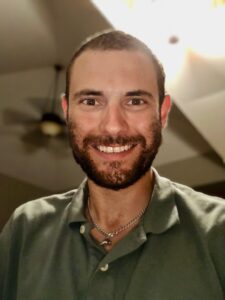
Frank Lehnerz is a Fort Collins-based engineer who works in the electric energy industry, and he is interested in promoting the message of Liberty.



Recent Comments